


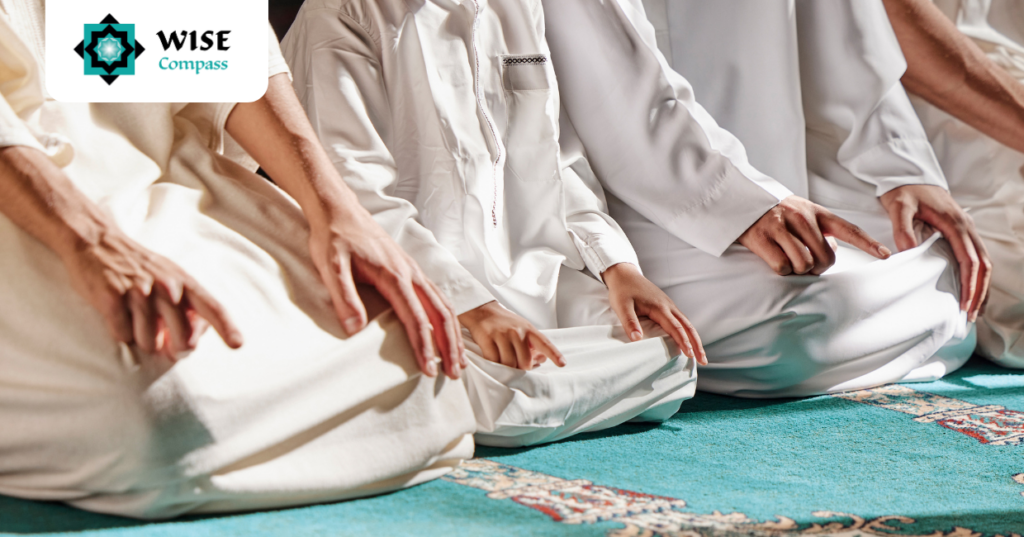
How to Perform Salah: Correct Actions and Sequence for Each Muslim Prayer

How to Perform Salah Correct Actions and Sequence for Each Muslim Prayer

Each set of Rakat (Unit of prayer) consists of up to 6 compulsory actions, known as the Arkaan (Pillars) of the prayer. Missing out any of these means the prayer must be redone or compensated (by performing Sajdah Al Sahaw (Prostration of Forgetfulness) at the end of the prayer). 

Face Qiblah and Make Niyyah (Intention) 

  • Stand facing the Ka’bah in Makkah.  
  • Make a mental or verbal intention, Niyyah, to offer prayer

Takbeer Tahreema – The opening Takbeer (Declaration of the Greatness of Allah Almighty) 

  • Raise hands to either side of the head, palms facing outwards 
  • Recite ‘Allahu Akbar’ (Allah Almighty is the Greatest

Qiyaam – Standing in prayer 

  • Stand upright, with right hand over the left hand, placed over the navel (for men), and over the chest (for women) 

Qiraat – Recitation 

  • Before every Surah, say: ‘Bismillah Al Rahman Al Raheem’ (I begin in the name of Allah (Almighty), the Most Beneficent and the Most Merciful) 
  • Recite Surah Al Fatihah  
  • Recite another Surah or portion of the noble Quran 
  • Recite ‘Allahu Akbar’ 

Ruku – Bowing 

  • (For men) Bow from the waist, at 90degrees to the floor 
  • (For women) Bow only far enough for hands to reach the knees 
  • Place hands on knees with the fingers pointing downwards 
  • Recite three times: ‘Subhaana Rabbiyal Azeem’ (Glory be to my Sustainer (Allah Almighty Who is) the Magnificent) 
  • Stand straight and recite once: ‘Sami Allahu liman hamidah’ (Allah Almighty hears all those who praise Him) 
  • Women are only required to bow down far enough for their hands to reach their knees. 

Sujood – Prostrating 

  • Recite ‘Allahu Akbar’ and then go into prostration, Sajdah, placing your palms, nose and forehead on the ground, also keep your knees and toes on the floor 
  • Females can place their close to their body and flat on the floor 
  • Males should keep arms straight and elbows off the ground 
  • In Sajdah, recite three times: ‘Subhaana Rabbiyal Aa’la’ (Glory be to my Sustainer (Allah Almighty Who is) Above and Beyond Everything) 
  • Recite ‘Allahu Akbar’ and then sit up briefly, with hands flat on legs 
  • Recite ‘Allahu Akbar’ and then perform a second Sajdah 

Sit in Tashahhud position 

  • Sit up from the second Sajdah, in kneeling position with hands flat on legs 
  • Females position feet to the side, with toes pointing forward 
  • Males sit with right foot positioned upright, with toes on the floor 
  • Recite verses of Tashahhud supplication 
  • Recite verses of Durood Shareef, praise on holy Prophet Muhammad ﷺ 

Qaidah Akhirah (also known as Salaam) – The Final Sitting 

  • Turn your head to face towards right shoulder 
  • Recite Assalaamu alaikum wa rahmatullah (Peace be upon you through the Mercy Allah Almighty) 
  • Turn your head to face towards left shoulder 
  • Recite Assalaamu alaikum wa rahmatullah 

THE SPECIAL IMPORTANCE OF RUKU, SUJOOD AND TASHAHHUD 

Ruku and Sujood are especially important in prayer, and holy Prophet Muhammad ﷺ has instructed us to complete them properly.  

It is reported in Sunan Nisai, Hadith 1054 that holy Prophet Muhammad ﷺ said: 

أَتِمُّوا الرُّكُوعَ وَالسُّجُودَ إِذَا رَكَعْتُمْ وَسَجَدْتُمْ 

‘Complete the bowing and prostration (properly and fully) when you bow and prostrate (in ritual prayer).’ 

It is reported in Sunan Ibn Majah, Hadith 872, that holy Prophet Muhammad ﷺ advised men to keep their backs completely straight when performing the Ruku: 

 يُصَلِّي فَكَانَ إِذَا رَكَعَ سَوَّى ظَهْرَهُ حَتَّى لَوْ صُبَّ عَلَيْهِ الْمَاءُ لاَسْتَقَرَّ 

‘I saw the Messenger of Allah Almighty  performing prayer, and when he bowed, he made his back so straight that if water were poured on it, it would have stayed there.’ 

It is recorded in Sahih Muslim, book 16, Hadith 1428, that holy Prophet Muhammad ﷺ said: 

أَقْرَبُ مَا يَكُونُ العَبْدُ مِنْ رَّبِّهِ وَهُوَ سَاجِدٌ، فَأَكْثِرُوا الدُّعَاءَ 

‘The closest (posture) that a servant (of Allah Almighty) can attain (in this material world) to his Sustainer, is when he is (prostrating) in Sujood, so increase your supplication (to Allah Almighty during such prostration)’ 

For men, it is recommended that the toes be bent forward and facing the Qiblah, during Sujood. Also, they must raise their elbows from the ground as this has been instructed by holy Prophet Muhammad ﷺ. It is reported in Sahih Bukhari, Hadith 822 that holy Prophet Muhammad ﷺ said: 

اعْتَدِلُوا فِي السُّجُودِ، وَلاَ يَبْسُطْ ذِرَاعَيْهِ كَالْكَلْبِ 

‘Do the prostration properly (and fully) and do not put your forearms flat with elbows touching the ground like the dog.’ 

Tashahhud is a precious aspect of Salah and literally means ‘to witness’. In this position we repeat the supplication which holy Prophet Muhammad ﷺ made when he entered the presence of Allah Almighty on the ‘Me’raaj (Ascension). Tashahhud is a powerful and precious reminder to the worshipper of a time of utmost humility and rejoicing for mankind. 

In this position, men must sit with their knees facing forward, sitting on their left foot with their right foot upright and its toes facing forward, in a semi-reposing ready stance.  

Women must sit with their knees facing forwards, feet positioned to their side, and toes facing forward, in the direction of Qiblah. 
Maulana Hafiz Asim Awan
Shaykh Asim Awan
Author

LLB, BA Islamic Scholar, Solicitor & Senior Partner

Graduate of Hijaz College, Maulana Asim completed his LLB at the University of London while he was studying at Hijaz College, attaining an MA Islamic Law and Theology in 2009. He is a qualified solicitor working in Birmingham. He is a Hafiz of the Quran and has been teaching Islamic theology since his graduation. He is also the curriculum convener for the Hijaz Diploma course and a key member of the Muslim Arbitration Tribunal. He is happily married and a father of three beautiful children.