

Salah (also known as Namaz) is one of the 5 Pillars of Islam, that is compulsory for every able-bodied Muslim to perform in order to fulfil the religion and be considered a Muslim.
Salah is described as protection from evil and immorality in the noble Quran. Allah Almighty tells us in the noble Quran at Surah Al Ankaboot (29), Verse 45 that:
إِنَّ الصَّلَاةَ تَنْهَىٰ عَنِ الْفَحْشَاءِ وَالْمُنكَرِ
Indeed, praying restrains (mankind) from immoralities and all irrational actions
This establishes Salah as a spiritual protection and moral safeguard for all mankind and lets us know that prayer is not just a ritual or tick-box exercise, but a gift and protection granted to mankind.
Salah also separates a believer from a disbeliever and helps the Ummah unify together for the sake of Allah Almighty. It is reported in Sahih Muslim, Hadith 82 that holy Prophet Muhammad said:
إِنَّ بَيْنَ الرَّجُلِ وَبَيْنَ الشِّرْكِ وَالْكُفْرِ تَرْكَ الصَّلَاةِ
Indeed, (the gap) between a man and icon worshipping paganism and extremity of disbelief is when he abandons the (five times) prayer.
It is reported in Jami Tirmidhi, Hadith 2621 that holy Prophet Muhammad ﷺ said:
الْعَهْدُ الَّذِي بَيْنَنَا وَبَيْنَهُمُ الصَّلَاةُ، فَمَنْ تَرَكَهَا فَقَدْ كَفَرَ
The (difference in) adherence between us (the Muslims) and them (the non-Muslims) are (identified by) the (five times) prayer; whoever abandons it has indeed committed extremity of disbelief.
The 5 Prescribed Prayers in Islam (also known as Salah and Namaz) are filled with wisdom from beginning to end. These have been prescribed by Allah Almighty Himself, granted directly to holy Prophet Muhammad ﷺ and is a gift for mankind from the Divine.
These 5 prayers are a means through which we converse and connect with Allah Almighty and become closer to Him. They are spread throughout the day to bless and balance a believer’s life with the remembrance of Allah Almighty from morning until evening.
It is important as believers to understand how to perform the prayer correctly, know the associated rulings for these ritual prayers and reflect on the wisdoms behind the actions in the prayer.
In practical terms, Salah is a sequence of physical actions performed while reciting prescribed verses from the noble Quran in set units of prayer, known as Rakat. Every one of the 5 Prescribed Prayers has a set number of Rakats (Units of prayer), and all Rakats follow the same sequence of actions and recitations.
The Rakats are classified according to 4 key types or categories, which refer to how necessary they are. These are:
Fard – Obligatory, cannot be missed
Waajib – Necessary; tantamount to obligatory
Sunnah – Prophetic practice (something that holy Prophet Muhammad ﷺ did in addition to Fard actions), highly recommended and not to be missed without good reason
Nafal – Optional, recommended for personal betterment but can be omitted
Every Rakat in Salah contains obligatory and necessary actions within it. If these are missed out or not performed correctly, our Salah is unacceptable and cannot be considered complete. Therefore, it is vital that every praying believer educates themself about these.
Rakat in Salah are read in units of 2, 3 and 4 at a time. Each set of Rakat consists of 6 compulsory actions, known as the Arkaan (Pillars) of the prayer. To omit any of these Arkaan means the prayer is not complete and the worshipper has to compensate for the missed action (by performing Sajdah Sahav (Prostration of Forgetfulness) at the end of the prayer) or repeat the whole set of Rakats again.
The 6 Arkaan are:
In addition to these 6 Fard Arkaan, every Rakat must also follow a number of Waajib actions in Salah, as these are also necessary in order for the prayer to be considered complete.
These Waajib actions are:
These rulings may seem like technicalities, but it becomes much easier to understand them as we practice and perform our Salah.
It is one of the greatest gifts of self-development and self-discipline for us to strive to perfect our prayers in every way – inwardly and outwardly. When we do this, we are better able to obtain the true benefit from the treasure of Salah and please Allah Almighty with our best efforts.
Salah has been described as the Me’raaj Al Mumineen, meaning the Ascension of the Believer, because it is through the prayer that a person potentially reaches proximity with Allah Almighty.
Each part of the prayer has been designed by Allah Almighty with spiritual blessing and meaning. If we learn to recognise the actions of Salah as meaningful steps on the journey to becoming closer to Allah Almighty, then we see beyond the ritual actions to the spiritual treasure hidden in each act.
Facing Qibla (Direction of prayer, Ka’bah in Makkah), raising our hands and declaring the greatness of Allah Almighty in the opening Takbeer of every Salah, symbolises putting the world behind us. When we enter into prayer, we focus fully on Allah Almighty.
Standing in Qiyaam, our minds are in a higher position than our hearts. This can be understood as our current state in the world; standing unbowed and vested in self-interest. In this state, we call upon Allah Almighty and ask for guidance.
Our Quranic recitation is a necessary and appropriate step of addressing and praising the One Whom we stand before, Allah Almighty, the Absolute Creator.
In the bowing position, we begin to submit and humble ourselves further in prayer as our mind is positioned equal to our hearts in Ruku.
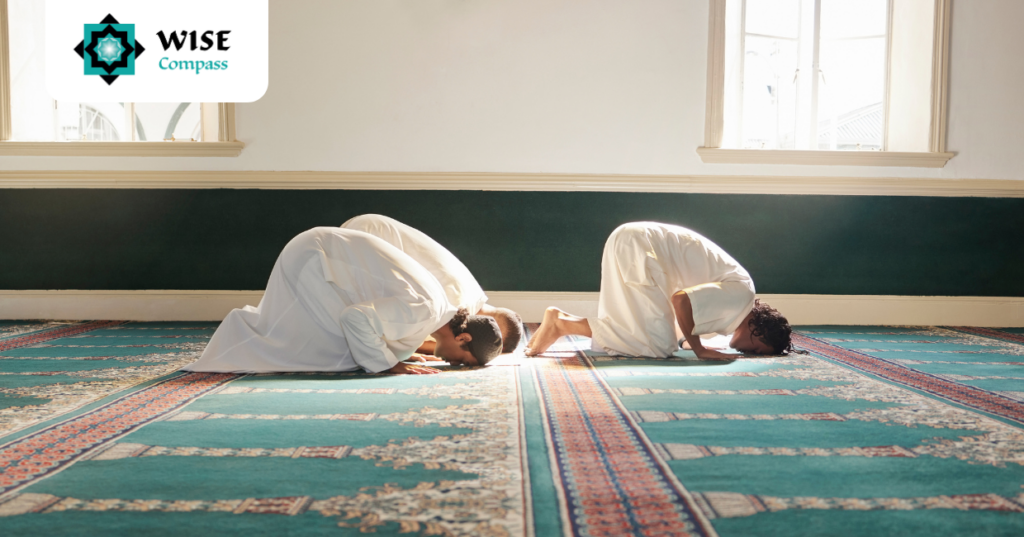
The most sublime position in prayer, is prostration. While literally the lowest spot, it is actually the pinnacle of submission in the prayer when a person places their head upon the floor before Allah Almighty. It is recorded in Sahih Muslim, book 16, Hadith 1428, that holy Prophet Muhammad ﷺ said:
أَقْرَبُ مَا يَكُونُ العَبْدُ مِنْ رَّبِّهِ وَهُوَ سَاجِدٌ، فَأَكْثِرُوا الدُّعَاءَ
‘The closest (posture) that a servant (of Allah Almighty) can attain (in this material world) to his Sustainer, is when he is (prostrating) in Sujood, so increase your supplication (to Allah Almighty during such prostration)’
Here the heart is placed higher than the mind, with both in absolute submission to Allah Almighty. This signifies the surrender of our will, mind and selves to what Allah Almighty wills for us.
The sitting position is where the worshipper completes the spiritual journey of prayer and repeats the supplication of holy Prophet Muhammad ﷺ, when he entered the presence of Allah Almighty during Me’raaj (Ascension). The term Tashahhud literally translates as ‘to bear witness’ and symbolises the worshipper bearing witness that there is none worthy of worship except Allah Almighty and holy Prophet Muhammad ﷺ as the final and Last Messenger of Allah Almighty.